The history of Jubilee House
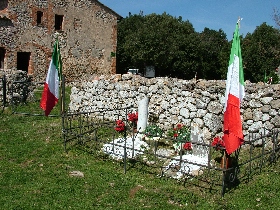
On March 28, 1944 a large contingent of soldiers of the GNR of Siena arrived at the Casa Jubileo with the aim of capturing the partisans who had taken refuge in the farmhouse where the Vannoni family lived at the time. In the second half of March 1944 a partisan group in contact with the Garibaldi Brigades operating in the northeastern area of the province of Siena They settle on Montemaggio with the aim of creating disturbance and sabotage actions against the Nazi-fascist occupation troops. The farmhouse where the Vannoni family lived became a reference point for a partisan group led by Velio Menchini, known as “Pelo”, where the massacre of Montemaggio took place on 28 March 1944. At dawn the farmhouse was surrounded by a large contingent of soldiers of the GNR of Siena, informed of the presence of the partisans by a fascist of the area, who started a firefight at the end of which the 19 partisans were captured, two killed, and two others managed to escape. The capture was followed by the shooting carried out by the fascists with fierce determination in the locality of Porcareccia, not far from the Jubilee House.
A partisan, Vittorio Meoni, managed to escape the massacre, thanks to which it was possible to reconstruct the events that would otherwise have remained known only from written documentation produced by the GNR, which tells a version of the events very different from what happened in the reality of March 28, 1944.
In the aftermath of the war, those responsible for the massacre were subjected to judicial proceedings which resulted in numerous convictions.
Over the years, local institutions have interpreted the will and feelings of the citizens, creating a context that handed down the memory of the event that so deeply marked the communities of Siena and beyond. In fact, the Montemaggio massacre remains the most important massacre in Tuscany.
In 1997, the Jubilee House was inaugurated as a Shrine of Memory and a place designed to be enjoyed through thematic visits.